Running a medical center without tracking the right Key Performance Indicators (KPIs) is like managing a business without knowing whether it is actually growing.
Many medical center managers monitor revenue at the end of the month, but revenue alone does not explain what is happening inside the business. A center may generate strong revenue while losing patients, wasting appointment capacity, experiencing high no-show rates, or operating with inefficient staff utilization.
Healthcare KPIs give managers a clearer view of operational performance, patient experience, financial health, and growth opportunities.
For medical centers in competitive markets such as Egypt and Saudi Arabia, tracking the right metrics can help managers identify problems earlier, improve resource utilization, increase patient retention, and make better business decisions.
What Are Healthcare KPIs?
Healthcare Key Performance Indicators are measurable metrics used to evaluate the performance of a medical center, department, service, or process.
The important point is not simply collecting data. A useful KPI should help management answer a business question.
For example:
- Are we using our doctors’ available capacity efficiently?
- How many booked appointments turn into actual visits?
- How much revenue does each patient generate?
- Are patients coming back after their first visit?
- How much does it cost us to acquire a new patient?
- Which services are generating the strongest margins?
- Where are we losing revenue operationally?
A strong KPI system connects daily operations with larger business outcomes.
Why Medical Centers Need a KPI System
Without structured KPI tracking, managers often rely on assumptions.
A manager may believe that the center needs more doctors when the real problem is poor appointment scheduling. Another may increase marketing spending when the actual issue is low booking conversion at the front desk.
Healthcare KPIs help separate symptoms from causes.
They also allow management to:
- Detect operational inefficiencies.
- Improve appointment utilization.
- Monitor staff and physician performance.
- Reduce revenue leakage.
- Understand patient behavior.
- Measure marketing effectiveness.
- Improve patient retention.
- Compare branches or departments.
- Make decisions based on data rather than intuition.
The goal is not to track dozens of numbers. The goal is to identify the metrics that directly influence profitability and growth.
The Most Important Healthcare KPIs for Medical Centers
1. Appointment Utilization Rate
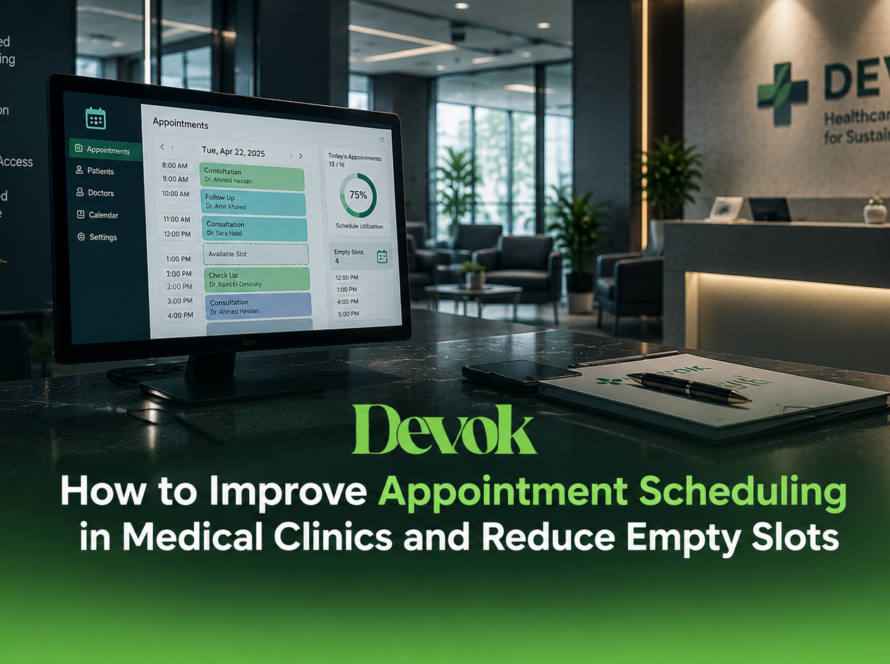
Appointment utilization measures how much of the available appointment capacity is actually being used.
A simple formula is:
Appointment Utilization Rate = Completed Appointments ÷ Available Appointment Slots × 100
For example, if a doctor has 100 available appointment slots during a period and only 75 are completed, utilization is 75%.
A low utilization rate may indicate:
- Weak demand.
- Poor scheduling.
- Excessive appointment gaps.
- High cancellations.
- High no-show rates.
- Inefficient physician schedules.
This KPI is especially important because unused appointment capacity represents revenue that cannot be recovered once the time has passed.
2. No-Show Rate
No-shows are one of the most common sources of operational and financial waste in medical centers.
No-Show Rate = Missed Appointments ÷ Total Scheduled Appointments × 100
A consistently high no-show rate can affect physician productivity, staff utilization, patient flow, and revenue.
Managers should not only monitor the overall no-show rate. They should also analyze it by:
- Doctor.
- Specialty.
- Appointment type.
- Patient segment.
- Booking source.
- Time and day.
This can reveal patterns that allow the center to improve confirmation and reminder processes.
3. Cancellation Rate
Cancellation rate measures how frequently scheduled appointments are cancelled.
However, managers should distinguish between cancellations made early enough to refill the slot and last-minute cancellations.
A cancellation two days before the appointment may create an opportunity to reschedule another patient.
A cancellation 30 minutes before the appointment can create an almost impossible-to-fill gap.
Tracking both overall and last-minute cancellation rates gives management a more accurate picture of lost capacity.
4. Booking Conversion Rate
Getting inquiries does not necessarily mean getting patients.
Booking conversion rate measures how effectively the center converts inquiries into confirmed appointments.
Booking Conversion Rate = Confirmed Appointments ÷ Qualified Patient Inquiries × 100
For example, if 200 potential patients contact the center and 80 book appointments, the booking conversion rate is 40%.
A low conversion rate may indicate problems with:
- Response time.
- Front desk communication.
- Pricing communication.
- Availability.
- Follow-up.
- Patient trust.
- Booking process complexity.
This KPI connects marketing performance with front-desk performance.
5. Patient Retention Rate
Acquiring a new patient is only part of the growth equation.
Patient retention measures how effectively a medical center keeps patients returning for additional visits or services.
A high retention rate can reduce dependence on constantly acquiring new patients and improve the lifetime value of each patient.
Managers should monitor retention by:
- Specialty.
- Doctor.
- Service.
- Patient type.
- Acquisition source.
For example, if patients acquired through one marketing campaign have a significantly lower retention rate than patients from another source, the center should investigate why.
6. Patient Lifetime Value
Patient Lifetime Value (LTV) estimates the total revenue a patient generates during their relationship with the medical center.
A simplified calculation can be:
Patient LTV = Average Revenue per Visit × Average Number of Visits
A more detailed model can include treatment value, retention period, service mix, and contribution margin.
LTV is particularly useful when evaluating marketing performance.
A campaign that generates patients at a low acquisition cost may not necessarily be successful if those patients rarely return.
7. Revenue per Patient
Total revenue can sometimes hide important performance differences.
Revenue per patient helps management understand how much revenue the average patient generates.
Revenue per Patient = Total Revenue ÷ Number of Patients
This KPI can be analyzed by doctor, specialty, branch, treatment, or acquisition channel.
For example, two departments may have similar patient volumes but significantly different revenue per patient.
That difference can help management evaluate service mix, pricing, treatment acceptance, and patient retention.
8. Patient Acquisition Cost
Patient Acquisition Cost (PAC) measures how much the center spends to acquire a new patient.
A simplified formula is:
Patient Acquisition Cost = Total Marketing and Acquisition Costs ÷ Number of New Patients
This metric should not be evaluated independently.
Managers should compare acquisition cost with patient lifetime value.
If acquiring a patient costs 500 EGP but that patient generates only 300 EGP in contribution margin, the acquisition strategy requires attention.
The same principle applies to Saudi Arabia, where acquisition costs can vary significantly by specialty, city, and marketing channel.
9. Average Waiting Time
Patient experience is strongly influenced by how long patients wait before seeing the doctor.
Average waiting time measures the time between the patient’s scheduled or arrival time and the actual consultation.
Long waiting times may indicate:
- Poor scheduling.
- Overbooking.
- Physician delays.
- Inefficient patient flow.
- Registration bottlenecks.
- Poor coordination between departments.
Reducing waiting time can improve patient satisfaction while also improving operational efficiency.
10. Doctor Utilization Rate
Medical centers sell professional capacity.
That makes physician utilization one of the most important operational KPIs.
Managers should compare the physician’s available working hours with the hours actually used for patient care.
Low utilization may mean that the center has excess capacity.
Extremely high utilization, however, can also be problematic because it may increase waiting times, reduce flexibility, and contribute to staff burnout.
The goal is not maximum utilization at any cost. The goal is sustainable utilization.
11. Revenue per Doctor
Revenue per doctor helps management evaluate physician productivity from a business perspective.
It can be tracked monthly and compared across:
- Specialties.
- Branches.
- Working hours.
- Appointment volumes.
- Service types.
This KPI should never be used alone to judge clinical performance. It is a business performance indicator that should be considered alongside patient experience, quality, and operational metrics.
12. Patient Satisfaction Score
Patient satisfaction provides insight into the quality of the overall patient experience.
Depending on the center’s system, managers can track:
- Overall satisfaction.
- Reception experience.
- Waiting time.
- Doctor interaction.
- Communication.
- Follow-up.
- Likelihood to recommend.
A center should not simply collect satisfaction scores. Management should identify recurring issues and connect them with operational data.
For example, if satisfaction drops at a specific branch while waiting time increases, the relationship between the two metrics becomes a valuable management insight.
Financial KPIs Medical Center Managers Should Track
Operational KPIs should be connected to financial performance.
Important financial indicators include:
Gross Revenue
Tracks the total revenue generated by the center before relevant deductions and expenses.
Operating Costs
Includes expenses such as salaries, rent, utilities, supplies, technology, maintenance, and other operating expenses.
Revenue Growth Rate
Measures how revenue changes over a defined period.
Profit Margin
Shows how much profit remains after costs.
Cost per Patient
Cost per Patient = Total Operating Costs ÷ Number of Patients
This helps managers understand whether patient growth is actually improving the economics of the center.
How to Build a Practical Healthcare KPI Dashboard
A KPI dashboard should make performance easier to understand, not create another administrative burden.
A practical dashboard can be divided into five categories:
1. Operations
- Appointment utilization.
- No-show rate.
- Cancellation rate.
- Doctor utilization.
- Waiting time.
2. Patient
- New patients.
- Returning patients.
- Retention rate.
- Satisfaction score.
- Patient lifetime value.
3. Marketing
- Leads.
- Booking conversion rate.
- Patient acquisition cost.
- New patients by channel.
- Campaign performance.
4. Financial
- Revenue.
- Revenue per patient.
- Operating costs.
- Cost per patient.
- Profit margin.
5. Management
- Branch performance.
- Doctor performance.
- Department performance.
- Service profitability.
- Monthly growth.
The dashboard should allow managers to compare current performance with previous periods and predefined targets.
Common Mistakes When Tracking Healthcare KPIs
Tracking Too Many Metrics
More data does not automatically mean better management.
Choose KPIs that directly influence your operational and financial goals.
Looking at KPIs Without Context
A 70% utilization rate may be good for one specialty and problematic for another.
KPIs need benchmarks and historical comparisons.
Measuring Revenue Without Measuring Costs
Revenue growth does not necessarily mean profit growth.
Managers need to understand the relationship between revenue, operating costs, and margins.
Reviewing KPIs Too Late
A monthly report may show that a problem happened, but real-time or weekly monitoring can help management act before the problem becomes expensive.
Keeping Data in Separate Systems
When appointment data, patient information, marketing data, and financial reports exist in disconnected systems, management may struggle to see the full picture.
Integrated healthcare management systems and dashboards can provide a more complete view of performance.
How Often Should Medical Centers Review Their KPIs?
Not every KPI needs to be reviewed at the same frequency.
Daily:
Appointments, cancellations, no-shows, waiting times, and capacity utilization.
Weekly:
Booking conversion, new patients, physician utilization, and operational performance.
Monthly:
Revenue, costs, patient retention, acquisition cost, lifetime value, and profitability.
Quarterly:
Branch performance, service profitability, strategic growth, and long-term trends.
The right frequency depends on the KPI and how quickly management can act on the information.
Turning Healthcare KPIs Into Better Business Decisions
The real value of KPIs is not the dashboard itself.
It is what management does with the information.
For example, suppose a medical center discovers that one doctor has a significantly lower appointment utilization rate than the rest of the team.
Instead of immediately increasing marketing spending, management could investigate:
- Appointment availability.
- Working hours.
- Booking conversion.
- Patient demand.
- Cancellation patterns.
- Doctor specialty.
- Marketing source.
- Pricing.
- Patient retention.
This approach helps identify the actual cause before investing more resources.
The strongest medical centers use KPIs as a management system rather than a reporting exercise.
How Devok Can Help
Tracking healthcare KPIs manually across spreadsheets and disconnected systems makes it difficult to understand what is really happening inside a medical center.
Devok helps medical centers build more structured management processes by connecting operational data, patient activity, performance monitoring, and business decision-making.
Instead of simply looking at numbers, management can use the right KPIs to identify operational problems, monitor performance, improve resource utilization, and build a clearer path toward sustainable growth.
If you want to understand which KPIs your medical center should track and how to turn your data into actionable management decisions, Devok can help you build a more structured approach.
Ready to manage your medical center with clearer data and better decisions? Contact Devok to book a consultation.